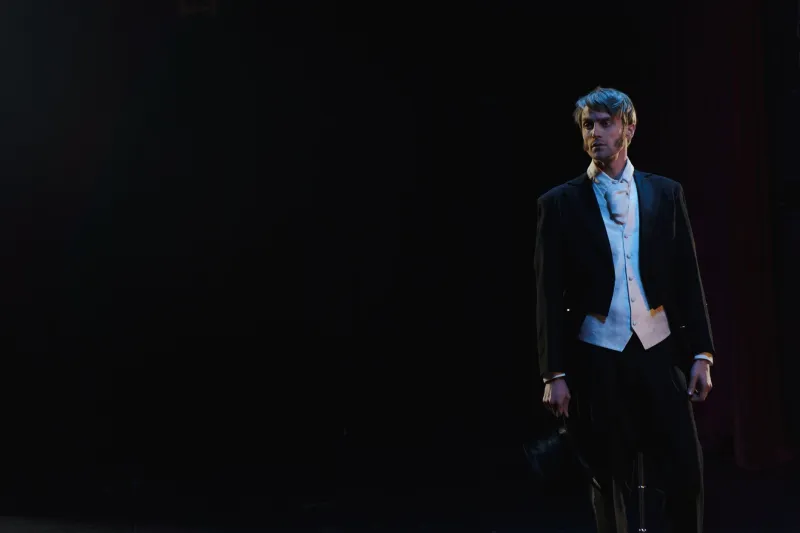
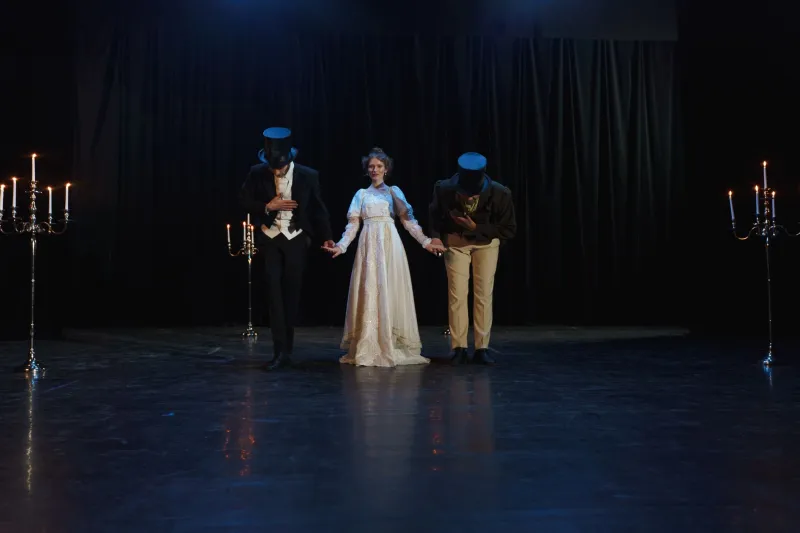
When the Bow Becomes the Story: What the Curtain Call Tells Us About Why Live Theater Still Matters
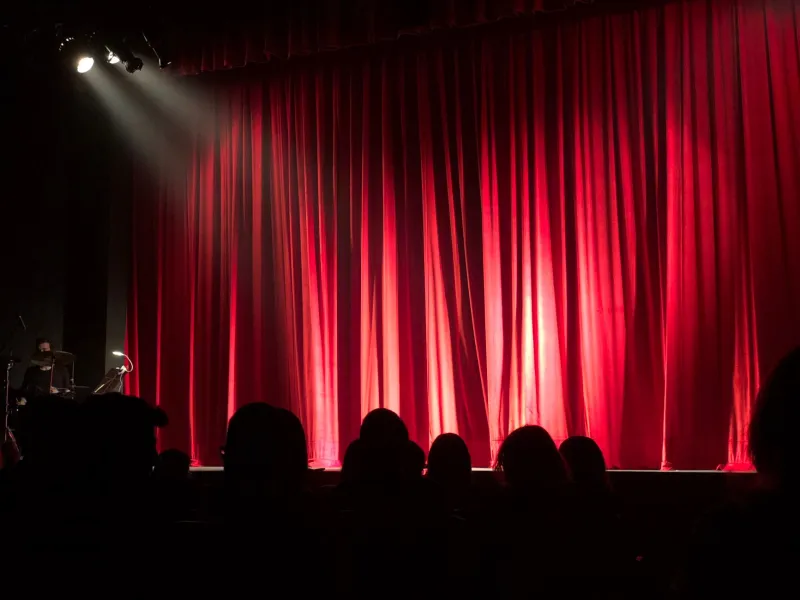
Somewhere between the final line of dialogue and the house lights coming back up, something strange and irreversible happens. The fiction dissolves. The performer steps forward. The audience leans in. And for a brief, electric window of time, two groups of strangers — one who pretended, one who watched — acknowledge each other across the dark.
That's the curtain call. And if you've ever been in a theater when it lands just right, you already know it can be the most powerful ninety seconds of the entire evening.
A Ritual Older Than Broadway
The curtain call didn't start in New York. It didn't start in London's West End, either. Its roots run deep into the soil of European theatrical tradition — particularly in the German-speaking world, where theater has long been treated less like entertainment and more like civic ritual.
In cities like Vienna, Munich, and Zurich, the curtain call is understood as a formal closing of a contract. The audience has given its time, its attention, its emotional vulnerability. The performers have given everything else. The bow is the receipt. Both parties sign it, wordlessly, together.
Austrian theater director and performer Franz Hochstätter, who spent two decades working between Vienna's Burgtheater and regional stages across the American Midwest, describes it this way: "In German-speaking theater, you are taught that the curtain call is not separate from the performance. It is the performance's last act. You are not just saying thank you. You are completing a conversation."
That framing — the bow as conversation — turns out to be remarkably resonant when you talk to American theatergoers about their own most memorable curtain call moments.
What Audiences Actually Remember
Ask someone to describe their favorite Broadway show and they'll usually reach for a song, a scene, maybe a set piece. Push a little harder, and a surprising number of people land on the curtain call.
Marielle Okonkwo, a 38-year-old teacher from Chicago, has seen more than sixty productions in the last decade. She describes watching a production of Fun Home in which the actor playing Alison walked downstage during curtain call and simply stood there — not bowing dramatically, just present — while the audience rose around her. "I started crying harder during the bow than I did during the show," Marielle says. "Something about seeing her as a person again, after everything she'd just given us. It broke me open in a different way."
That "different way" is worth sitting with. The curtain call doesn't just extend the emotional experience of theater — it recontextualizes it. You've spent two hours inhabiting a story. Now the story steps out of itself and looks you in the eye. The effect can be disorienting, humbling, occasionally euphoric.
David Reyes, a theater professor at a university in Austin, Texas, teaches a seminar on performance ritual that dedicates an entire week to the curtain call. "I ask my students: what is actually being exchanged in that moment?" he says. "And the answers are always more complicated than 'applause.' People talk about gratitude, recognition, shared survival. They use language you'd usually associate with religious experience."
The Unrepeatable Nature of the Thing
Here's what no streaming platform has ever figured out how to replicate: the curtain call is different every single night.
The same cast, the same show, the same theater — and yet Tuesday's bow carries nothing of Monday's energy. A standing ovation on a rainy Wednesday matinee hits differently than one on a Saturday night with a sold-out house. Performers talk about reading the room during curtain call the way a musician reads a crowd. Some nights the applause is polite and a little exhausted. Other nights it feels like the room is trying to say something it doesn't have words for.
For performers trained in the German-speaking theater tradition, this variability isn't a problem to manage. It's the whole point.
"You cannot manufacture that moment," says stage actress Lena Braun, who trained in Salzburg before relocating to New York and building a career in American regional theater. "Every night, you are meeting a specific group of human beings who had a specific experience. The curtain call is where you find out what that experience was. Sometimes it's quiet and tender. Sometimes it's overwhelming. You have to be present for whatever it is."
Braun pauses. "That presence — that's what streaming cannot give you. There is no curtain call on Netflix."
Why This Matters Right Now
We are living through a genuinely strange moment for live performance. Ticket prices are high. Attention spans are contested. The competition for an evening's entertainment has never been more intense or more frictionless. You can watch a prestige drama on your couch without changing out of your pajamas, without fighting for parking, without sitting next to a stranger who unwraps a cough drop at the worst possible moment.
And yet. Theater attendance, while still recovering from the pandemic's gut punch, has been showing real signs of resilience — particularly among younger audiences who grew up entirely inside the on-demand media landscape. Ask them why they keep coming back to live performance, and the curtain call comes up more often than you might expect.
"I go for that ending," says Jonah Kim, a 26-year-old graphic designer from Brooklyn who sees about a dozen shows a year. "Not even necessarily a standing ovation. Just that moment when everyone in the room is feeling the same thing at the same time. You can't get that anywhere else."
He's right. And that might be the curtain call's most radical quality in 2024: it is fundamentally, stubbornly communal. It requires bodies in the same room. It requires real-time emotional response. It cannot be replayed, rewound, or watched at 1.5x speed.
The Bow as Beginning
There's a tradition in some European theater houses — particularly in opera — of extending the curtain call until the applause genuinely dies of natural causes. No artificial cutoff. No house lights nudging the crowd toward the exits. The performers stay until the audience is truly finished.
It sounds almost absurdly old-fashioned. It also sounds, depending on your mood, like exactly what we're all starving for.
In a culture that has optimized nearly every experience for efficiency, the curtain call insists on something inefficient and human: mutual acknowledgment that takes as long as it takes. The performer says I was here, I gave this to you. The audience says We received it, we were changed by it. Neither party can rush the other.
That's not a small thing. That might, in fact, be everything.
The lights come up. The actors bow. And for a moment that is impossible to stream, impossible to save, impossible to skip — something passes between strangers that neither of them will entirely be able to explain afterward. They'll just know it happened. And they'll come back, again and again, hoping to feel it once more.