When Your Kitchen Doubles as a Black Box: The Quiet Rise of the Home Performance Studio
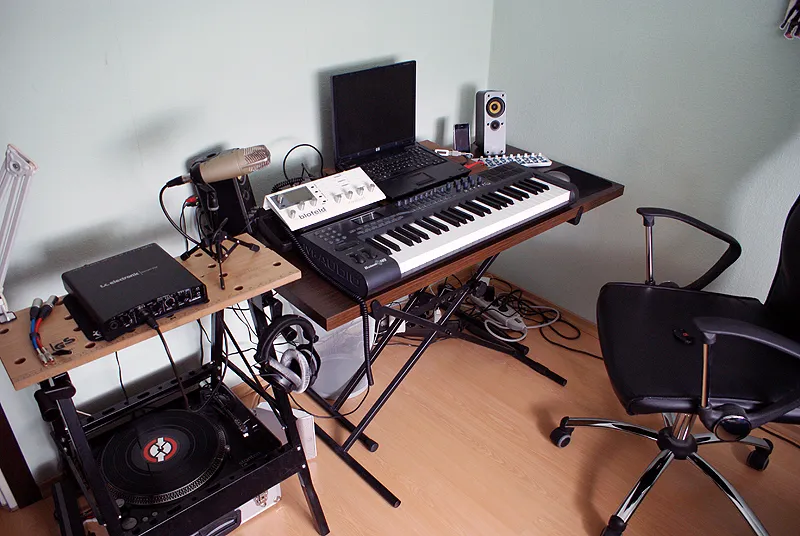
Photo: LiquidMolly, CC BY-SA 2.0, via Wikimedia Commons
Somewhere in a Queens apartment right now, a musical theater performer is taping a moving blanket to a bedroom wall. In a Los Angeles garage, an actor is adjusting a ring light for the fourth time this hour. And in a Chicago three-flat, a voice teacher has turned her pantry into a vocal booth with foam panels and, allegedly, a lot of hope.
This is the new green room. It doesn't have a coffee machine or a call sheet pinned to the wall. It has a tripod, a neutral backdrop, and a shelf of equipment that cost more than the first car some of us drove.
The Shift Nobody Planned
The migration of performance work into living spaces didn't happen overnight, and it wasn't purely a pandemic artifact — though the lockdown years certainly accelerated it. Casting offices moved to self-tapes. Voiceover work went fully remote. Voice lessons, coaching sessions, even whole workshops migrated to Zoom and stayed there because, frankly, the economics worked.
What started as a stopgap became infrastructure. And once performers realized they could audition from home, book voiceover gigs from a closet, and rehearse without paying for studio space, the question stopped being should I set something up? and became how much should I invest?
That second question is where things get messy.
What Working Performers Actually Built
Marcus Delgado, a working actor in Los Angeles, spent roughly $1,800 building what he calls his "audition corner" — a corner of his living room with a backdrop, two lights, a decent microphone, and acoustic treatment that is, in his words, "mostly thrift store blankets mounted with command strips."
"The first thing I bought was the expensive camera," he told me. "Total waste. My phone shoots better than the camera I bought in 2021. What actually changed my booking rate? Lighting and sound. That's it. Casting directors see you for ninety seconds. They don't care about your gear. They care that they can see your eyes and hear you clearly."
In New York, voice actor Priya Raman went the opposite direction — minimal visuals, maximal audio. Her setup lives in a converted coat closet lined with moving blankets and foam wedges.
"People think you need a $10,000 booth," she says. "I booked national commercial work from a closet that still has my winter coats in it. The blanket trick is real. Spend forty dollars before you spend four thousand."
The Procrastination Economy
Here's the uncomfortable pattern that kept surfacing in every conversation: the performers who book the most work tend to own the least equipment. The ones building elaborate studios, meanwhile, are sometimes building a very sophisticated way to avoid the actual work.
A director friend of mine calls it "gear theater" — the performance of preparing to perform. The new microphone arrives, and suddenly you need to re-record your demo reel, which means re-recording your demo reel requires new editing software, which requires a tutorial, which requires a weekend, which somehow becomes a month.
There's a real psychological comfort in setup. Setup feels like progress. But a self-tape shot on a phone against a blank wall, with honest lighting and clean audio, beats a cinematic masterpiece shot by an actor who spent three weeks building the set instead of three days living in the scene.
What's Actually Worth Buying
If you're going to spend money, here's the consensus from the people doing this professionally:
Worth it:
- Lighting, first and always. A basic key light and a reflector, or even a well-placed lamp, transforms a self-tape. Around $100–150.
- Sound treatment over sound equipment. Blankets, rugs, a closet full of clothes. Your phone's mic plus a quiet, dead-sounding room beats a $400 microphone in a live, echoey space.
- A reliable tripod and phone mount. Boring, cheap, essential.
- One pair of honest headphones for monitoring your own audio. You can't fix what you can't hear.
Skip it:
- The cinema camera. Truly. Your phone is better.
- The acoustic foam pyramid wall. It treats the wrong frequencies and makes your room look like a recording studio in a sitcom.
- The teleprompter app subscription you'll use twice.
- Anything you're buying before you've booked work with what you already have.
The Bigger Question
There's something worth naming here beyond the shopping advice. The home studio represents a genuine shift in who controls the means of performance. For decades, access to a stage, a booth, a camera — all of it was gatekept by someone else's budget and someone else's schedule. Now a teenager in rural Ohio can cut a demo tape that looks as professional as one shot in Manhattan.
That democratization is real, and it's good. But it also means the differentiator isn't the studio anymore. Everyone has the backdrop. Everyone has the light. When the infrastructure is universal, the only thing left that separates performers is the thing that always separated them: the work itself.
The green room is dead, sure. Long live the living room. But let's be honest about what we're decorating in there — a place to make art, or a very well-lit place to hide from it.