The Loudest Thing in the Room Is the Person Who Isn't Moving
The Loudest Thing in the Room Is the Person Who Isn't Moving
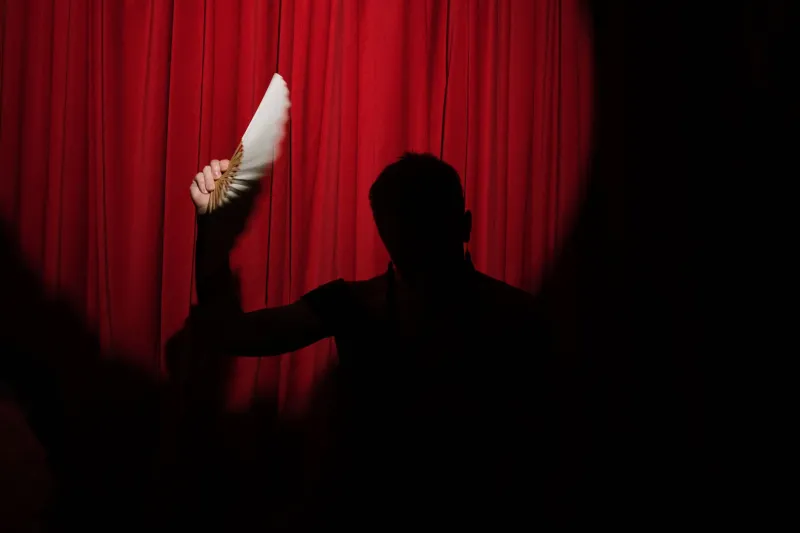
There's a moment in any great stage performance when the air changes. The other actors are speaking, maybe even shouting. The lights are doing something interesting. And yet your eyes — your entire nervous system — lock onto the one person who is completely, utterly still. Not frozen. Not absent. Present in a way that feels almost aggressive.
If you've seen that moment, there's a decent chance the performer holding that stillness learned their craft somewhere in the German-speaking world.
What American Training Gets Right (and What It Misses)
American actor training has given the world a staggering amount of good work. The legacy of Stanislavski, filtered through Lee Strasberg, Stella Adler, and Sanford Meisner, built an entire culture around emotional truth, physical spontaneity, and the kind of raw, lived-in authenticity that made Hollywood the storytelling capital of the planet.
But there's a bias baked into that tradition — toward action, toward expression, toward the idea that feeling something means showing something. Drama coaches across the US still lean heavily on the principle that the body should reflect the interior. Move when you're moved. React. Fill the space.
The German-speaking theater tradition — rooted in institutions like the Max Reinhardt Seminar in Vienna, the Ernst Busch Academy in Berlin, and conservatories across Zurich and Salzburg — arrives at the same destination by a very different road. And sometimes, that road runs straight through silence.
Stillness as Vocabulary
For performers trained in the Central European tradition, stillness isn't the absence of technique. It's one of the most demanding techniques there is.
Think of it as a vocabulary choice. An actor who has a full emotional toolkit can choose to project, to physicalize, to fill every beat with visible feeling. But a performer who has also mastered restraint has an entirely different word available — one that can stop a scene cold and redirect every bit of attention in the theater.
The principle, as coaches from this tradition often describe it, is something like: the body holds what the voice cannot say. When a character is overwhelmed, devastated, or dangerously calm, the most truthful response isn't always movement. Sometimes the most truthful response is an almost imperceptible shift in the eyes. A breath held a half-second too long. A hand that doesn't reach for the thing it wants.
American audiences, raised on the kinetic energy of film close-ups and sitcom timing, often describe watching this kind of performance as unexpectedly intense. "I didn't know where to look," is a phrase that comes up a lot. Which is exactly the point.
The Pause as a Dramatic Instrument
In German theatrical language, there's a concept that doesn't translate cleanly into English — the idea of the bedeutsame Pause, roughly the "meaningful pause." Not a hesitation. Not a dropped line. A deliberate, weighted silence that functions like a rest in music: not empty, but full of everything that came before it.
This isn't the pregnant pause of American melodrama, where you hold a beat before delivering the punchline or the gut-punch. It's something more structural — a pause that asks the audience to do work, to sit inside the ambiguity, to feel the weight of what isn't being said.
Performers who bring this technique to US stages often describe a period of recalibration. American directors, particularly in commercial theater, are trained to keep the pace moving. A pause can read as a problem — a missed cue, an actor losing their footing. It takes real trust, and sometimes real negotiation, to let the silence breathe long enough to do its job.
When it works, though, the effect is something audiences describe in almost physical terms. A stillness that lands in the chest. A moment that makes the theater feel smaller, more intimate, even in a house that seats a thousand.
Why Overstimulation Made This More Powerful, Not Less
Here's the irony: the very cultural conditions that might seem hostile to subtlety — the scroll culture, the algorithmic content churn, the 90-second attention span — have actually made the performers who know how to stop more compelling than ever.
When everything around us is competing for attention through volume and speed, the performer who goes quiet doesn't disappear. They expand. The contrast alone is disorienting in the best possible way. Your brain, trained to chase the next stimulus, suddenly has nowhere to go except deeper into the moment in front of it.
This is something Central European theater has understood for generations, partly because it had to. The great German-language stages — the Burgtheater, the Berliner Ensemble, the Schauspielhaus Zürich — built their reputations on a tradition of intellectual and emotional rigor that demanded audiences meet the work halfway. Spectacle was never the only tool. Often it wasn't even the primary one.
That ethos, transplanted to American stages and filtered through performers who grew up inside it, creates something genuinely unusual in the current landscape: a performer who trusts the audience enough to give them nothing — and knows that nothing will be enough.
What US Stages Are Starting to Learn
The influence is showing up in interesting places. Directors who have worked extensively with European-trained performers talk about a kind of recalibration that happens in the rehearsal room — a slowing down, a willingness to sit in discomfort rather than fill it. Acting coaches in New York and LA are increasingly incorporating what some loosely call "negative space" work into their curricula, though the terminology varies.
And audiences, often without knowing why, are responding. Post-show conversations about performances that leaned into restraint tend to circle around the same observations: I felt like something was happening that I couldn't quite name. I couldn't stop watching. I left feeling like I'd actually thought about something.
That last one might be the most telling. Because what the German-speaking tradition understands — what it has always understood — is that theater isn't just something you watch. At its best, it's something that happens to you. And the most powerful things that happen to us are often the quietest.
The Performer Who Knows When to Stop
There's a kind of courage in stillness that doesn't get talked about enough. It requires an actor to trust that they are enough — that their presence, without gesture or projection or movement, can hold a room. That's a harder thing to believe than it sounds, especially in a performance culture that has historically rewarded doing more.
But the performers who have come to American stages carrying this particular skill — this weaponized quiet — are making a case that the most compelling thing in any room isn't always the loudest thing. Sometimes it's the one that makes you lean forward, lower your voice, and wonder what you just felt.
In an era where everything is asking for your attention all at once, the performer who stops and waits might be the bravest one up there. And almost certainly the most unforgettable.