Silence Is the Exam You're Failing: Why American Performers Can't Stop Asking 'How Did I Do?'
Let me describe a scene that plays out in acting studios, conservatories, and casting offices across the country roughly ten thousand times a week.
Someone finishes a scene. They were in it — really in it. There was something alive happening. And then the moment it ends, before the director or teacher or casting director has drawn a full breath, the performer's eyes are already scanning the room. Searching. Asking, without words: Was that okay? Did you like it? What did I do wrong?
The silence between the end of the work and the beginning of the feedback has become, for a significant portion of American performers, almost unbearable.
That's not a small thing. That's a crisis.
What Silence Is Actually For
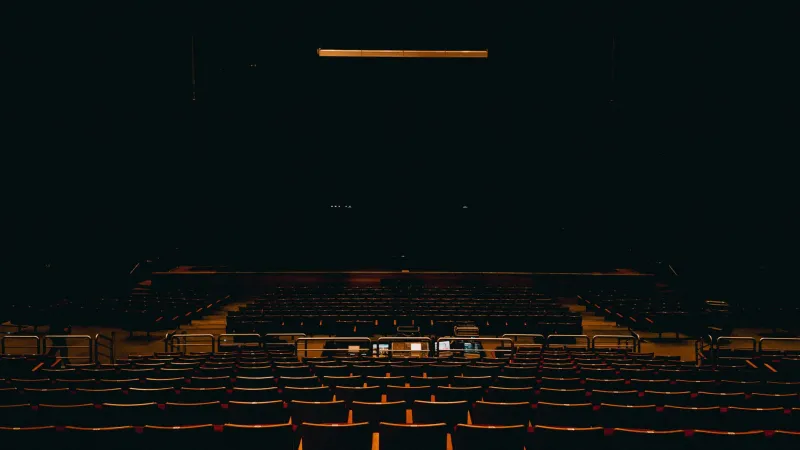
In several European theater traditions — particularly in German-speaking countries, Scandinavia, and parts of Eastern Europe — silence after a rehearsal run-through isn't awkward. It's expected. It's treated as a form of artistic digestion. The director sits. The actors sit. Nobody rushes to fill the air with reassurance or critique. The work is allowed to land, to settle, to mean something before anyone starts picking it apart.
This isn't some romantic notion of how artists behave in old movies. It's a pedagogical choice built into how institutions train their people. The silence is part of the curriculum.
In contrast, the American training pipeline — from university BFA programs to commercial acting coaches to the workshop circuit in New York and Los Angeles — tends to operate on a feedback loop that would make a social media algorithm proud. Scene ends, notes begin. Audition happens, callback timeline is immediately negotiated. Workshop concludes, evaluation forms are distributed. The message, repeated endlessly, is that the work is not complete until it has been assessed.
But here's the problem: if you train yourself to need external assessment to understand the value of your own work, you've handed the keys to someone else's car.
The Callback Culture and What It's Really Measuring
The American audition system is, in many ways, a masterpiece of efficiency. Submissions, appointments, first rounds, callbacks, chemistry reads, offers — it's a funnel designed to move quickly and produce decisions. That speed serves the industry's economic needs.
What it doesn't serve is the performer's interior development.
When your sense of whether a piece of work was good is entirely dependent on whether you got a callback, you've outsourced your artistic judgment to a process that is evaluating many things simultaneously — your look, your type, the chemistry with an already-cast lead, the budget, the director's mood that morning. The callback is real information, but it's not artistic information. Conflating the two is where things go sideways.
Talk to performers who've trained or worked extensively in Europe and you'll hear a version of the same story: the first time they walked out of a European audition or rehearsal into silence and got nothing back for days or weeks, it was genuinely disorienting. Then, slowly, something else happened. They started to develop their own internal assessor. They started trusting their own read on the work.
That internal assessor is arguably the most important instrument a long-career performer can develop. And the American system, for all its efficiency, doesn't really train it.
Uncertainty as a Skill
There's a term in sports psychology — tolerance for ambiguity — that describes an athlete's ability to function effectively when the outcome is unknown. Elite performers in high-pressure sports train this explicitly. They practice not knowing. They rehearse staying present in the uncertainty rather than collapsing into anxiety or false confidence.
The performing arts equivalent of this is the ability to sit with a piece of work — a scene, a role, a performance — and not immediately need it validated, explained, or scored.
This is a learnable skill. It is also a skill that is actively undermined by the structure of American performance training and the entertainment industry's feedback architecture.
Social media has made this exponentially worse. The performer who posts a clip of their showcase and immediately starts refreshing for likes is training their nervous system to need that dopamine hit to feel like the work mattered. That's not a moral failing — it's a structural one. The platforms are designed to create exactly that dependency. But for performers specifically, it's corrosive in ways that affect the actual craft.
What Introspection Builds That Feedback Can't
Here's what the European model — at its best — is actually training: the capacity for genuine self-knowledge. Not self-criticism, which can spiral into paralysis. Not self-congratulation, which produces complacency. Actual, clear-eyed self-knowledge.
Knowing what you did. Why you did it. What worked from the inside, not just what landed on the outside. Where you were present and where you were performing presence rather than actually being in it.
This kind of introspective rigor is what separates performers who have ten-year careers from those who have forty-year ones. It's what allows someone to walk offstage after a performance that the audience loved and know, privately, that it wasn't their best work — and then figure out why. It's also what allows someone to walk offstage after a performance that felt transcendent and not be destroyed when the reviews are mixed.
The external world will always be inconsistent. Reviews, callbacks, social media engagement, box office numbers — none of it is a reliable measure of the quality of the work. Performers who internalize that early tend to last. Those who don't tend to burn brightly and then burn out.
A Different Kind of Ambition
None of this is an argument against feedback, mentorship, or the kind of rigorous outside eye that great directors and teachers provide. That stuff is invaluable. The question is about proportion and dependency.
The performer who can work in silence — who can rehearse a role for weeks without a standing ovation, who can sit with uncertainty without spiraling, who can evaluate their own work honestly without needing someone else to hand them the verdict — that performer has something the industry increasingly can't manufacture on demand.
They have patience with their own process.
And in a business that moves faster and faster and demands more and more immediately, that patience might be the most countercultural, most powerful thing an American performer can develop.
The room full of silence isn't the enemy. It's the classroom. The question is whether you're willing to sit in it long enough to learn.