Nobody Claps in Munich: What American Standing Ovations Are Costing Us
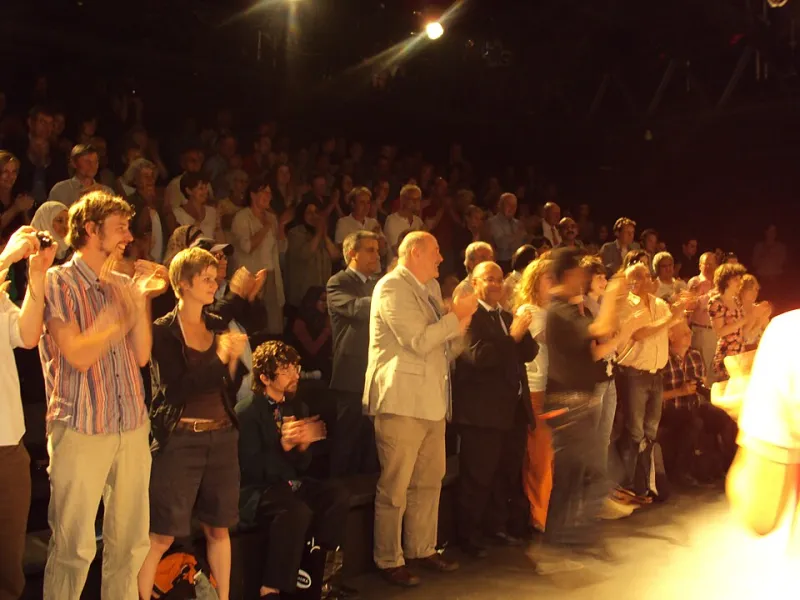
Photo: Amr.b.alalas, CC BY-SA 4.0, via Wikimedia Commons
Let's start with a list of things that received standing ovations on Broadway in the past year, according to friends of mine who work in theaters and keep informal track of these things:
- A genuinely transcendent revival that will be discussed for decades.
- A musical that closed after six weeks.
- A Tuesday matinee with half the house comped.
- A performance where a lead actor forgot an entire verse and recovered.
- Every single show, as far as anyone can determine, since roughly 2015.
The standing ovation has stopped being an honor and become a choreography. We rise because the people beside us rise, because the person in row F rises, because — let's be honest — we want to be the kind of audience that rises. It's applause as self-image. And it's quietly wrecking one of the best things live performance has going for it: the possibility of an honest reaction.
The Inflation Problem, Explained by Economics
Any currency loses value when you print too much of it. Applause works the same way. If a standing ovation is the highest denomination of audience approval, and we spend it on everything, then we've effectively devalued the entire currency. Now the only signal left is degree: how fast people stood, how many stayed seated, how long the clapping ran. Audiences have become amateur analysts of ovation forensics because the baseline signal is dead.
Performers feel it too. Ask any working actor what a standing O means anymore and watch the shrug. The ovation that would have made a career-defining night in 1985 is now just... Tuesday. The ceiling rose until it hit the sky, and now nobody can tell how high anything is.
What Happens When Silence Is Allowed
In much of Europe — Germany and Austria especially — audiences sit through applause with their hands in their laps, and it is not an insult. It is information. A German audience that gives you a Bravo has made a decision. A Viennese audience that knocks with their feet (a real and startling tradition) has made a much louder one. And yes, booing survives in some European opera houses and festivals not as cruelty but as honest participation. The audience is a participant in the event, not a consumer issuing a mandatory five-star review at the exit.
I'll never forget watching a Munich audience sit in near-total stillness after a well-reviewed touring production that would have gotten a rock-concert ovation in any American city. My American companion was mortified. The actors, I later learned, were not. They read that silence exactly as it was meant: a serious room, reserving judgment, taking the work seriously enough not to flatter it.
Why We Can't Stop Clapping
The American ovation habit isn't pure phoniness — it's a tangle of things. Ticket prices create a need to feel the evening was worth it, and rising to your feet is a physical way of confirming your own purchase. Social media turned the ovation into content: film it, post it, prove you were there for something great. And Broadway marketing has learned that ovation footage sells tickets, so every night is now, functionally, a filmed commercial.
There's also a kindness culture at work, and I don't entirely knock it. Americans are generous audiences. We want performers to feel good. But somewhere along the way, generosity became obligation, and obligation became noise.
What We're Losing
Here's the thing that makes live performance electric: the audience can do anything. That's the whole product. A recording is fixed; a room is alive. The electricity comes from the possibility that the room might go quiet, or erupt, or — rarest of all — hold its breath. When every possible reaction has been pre-converted into a standing ovation, the room stops being alive. The audience becomes scenery.
And the performers lose their most honest feedback loop. An actor told me once that the most useful review of her career was a house that stayed seated but leaned forward the entire second act. "Silence with attention," she called it. "You can't get that if the room has already decided to stand."
A Modest Proposal
Nobody's asking American audiences to start booing. We have neither the tradition nor the temperament. But consider this: stay seated the next time your body doesn't insist on standing. Clap hard for what moved you. Save your feet for the night that earns them. The performers — the good ones, the ones worth watching — will notice. And the rare ovation, when it finally comes, might mean something again.
Applause is a language. We're currently shouting it, all caps, every sentence. Somewhere in Munich, a room full of people just said something devastating by saying nothing at all.