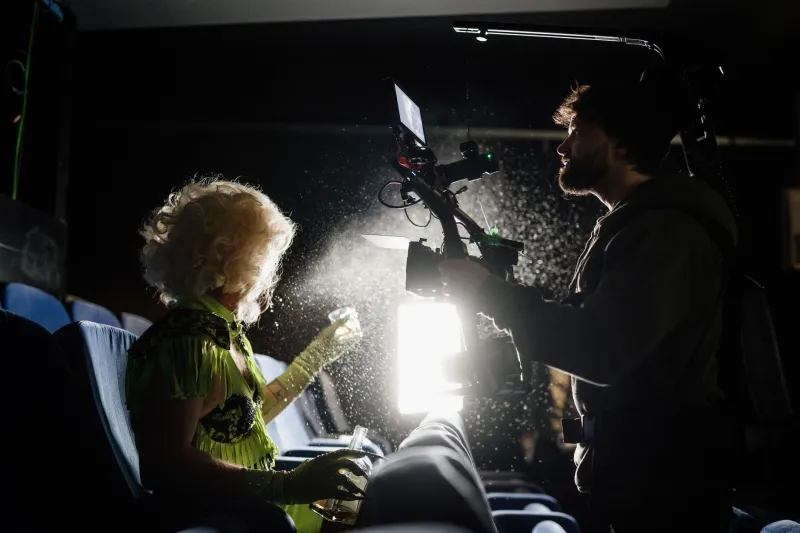
The Accent in the Room: Why Hollywood Is Finally Casting the 'Wrong' Voice

There's a story that circulates in certain acting circles — the kind that gets told at industry panels and conservatory alumni events — about an Austrian actor who spent the first three years of his American career being told, in various polite and not-so-polite ways, that his accent was going to be a problem. Then he booked a role that called for exactly that accent, played it without apology, and suddenly the thing he'd been asked to fix became the thing everyone wanted to hire.
This story has a hundred variations. The details change — the country of origin, the specific production, the casting director who finally got it — but the arc is remarkably consistent: the perceived liability eventually becomes the defining asset.
And lately, that arc is getting shorter.
The Old Gatekeeping
For most of Hollywood's history, the rules around accent and origin were pretty clear, even when they were never officially written down. American roles went to Americans, or to actors who could convincingly pass as American. An authentic foreign accent was acceptable in a villain, a comic sidekick, or an exotic love interest — the kind of role that was defined by its otherness. But for anything considered central to the American experience, the expectation was assimilation: neutralize the accent, soften the edges, fit the mold.
This wasn't entirely cynical. It reflected a genuine (if limited) belief about what American audiences would accept. The industry ran on assumptions about viewer identification, and the assumption was that American viewers needed American voices to see themselves in a story.
The problem, of course, is that America has always been a country of voices — plural, layered, accented, hyphenated. The idea that there's one authentic American sound was always a fiction, and a fairly recent one at that.
What Changed
Several things shifted more or less simultaneously, and their combination has been genuinely transformative.
Streaming platforms opened the market to international content in a way that fundamentally changed American viewer expectations. When audiences spent years watching and loving shows from Germany, Scandinavia, South Korea, and Spain — often with subtitles, often with zero concession to American sensibility — the idea that foreign voices were inherently distancing started to look pretty thin.
At the same time, American storytelling itself got more interested in specificity. The prestige drama era — the long run of cable and streaming shows that prioritized character complexity over plot machinery — created a demand for performers who brought something genuinely particular to a role. And genuine particularity is very hard to fake.
A German actor playing a German-American character doesn't need to research what it feels like to navigate two cultural identities. They've lived it. That lived knowledge shows up in choices that are almost impossible to replicate through preparation alone.
The Performers Rewriting the Rules
Look at the contemporary landscape of American film and television and you'll find non-native English speakers not just in international co-productions but in roles that would have been unthinkable for them a decade ago.
Actors from Austria, Germany, Hungary, and the broader Central European tradition have been particularly visible — partly because of the region's extraordinary theatrical training infrastructure, and partly because the physical and emotional precision that training produces translates exceptionally well to camera work. European conservatories tend to train bodies as rigorously as voices, and that physicality reads as presence on screen in a way that's immediately compelling.
What these performers bring, beyond technical skill, is a perspective that's genuinely outside the American entertainment ecosystem. They haven't grown up watching the same references, absorbing the same cultural shorthand, defaulting to the same emotional registers. That outsider lens, applied to American material, can crack a role open in unexpected ways.
Authenticity as a Casting Criterion
The industry conversation around authenticity has mostly focused on racial and ethnic representation — who gets to tell which stories, and why that matters. That conversation is important and ongoing. But there's a parallel conversation happening around national and linguistic identity that's less visible and equally interesting.
When a casting director chooses a non-native English speaker for a role that could have gone to a native speaker, they're often making a bet on a specific kind of truth. The slight friction of a non-native speaker navigating English — the moments where word choice becomes more deliberate, where the relationship to language is slightly more conscious — can create a texture in a performance that reads as interior life.
It's not that the accent is the point. It's that the specific experience of living between languages and cultures produces a quality of attention — a way of inhabiting the present moment — that's genuinely difficult to manufacture.
Five Reasons the 'Foreign' Performer Has the Edge
1. They've already done the hardest audition. Moving to a new country, learning to navigate an industry in a second language, building a career from scratch without a network — that's a resilience stress test most performers never face.
2. They bring genuine outsider perspective to American material. Sometimes the most illuminating reading of a quintessentially American story comes from someone who encountered it without the baggage of growing up inside it.
3. Their training is usually rigorous in ways American programs aren't. European conservatories, particularly in the German-speaking world, tend to run longer, demand more physical discipline, and produce graduates with a broader technical range.
4. Their accents are real. In an era when audiences have become increasingly sensitive to inauthenticity, a genuine accent — even an unexpected one — reads as truthful in ways a performed one often doesn't.
5. They've had to develop range. An actor who's played roles in multiple languages, for multiple cultural contexts, has been forced to find what's universal in a character rather than relying on cultural shorthand.
The Shift That's Still Happening
None of this means the gatekeeping is gone. It isn't. There are still rooms where an accent triggers a particular kind of hesitation, still producers who default to the familiar, still the lingering assumption that American audiences need American voices.
But the direction of travel is clear. The performers who used to be told to neutralize their accents are increasingly being told that the accent is exactly what got them the job. The outsider perspective that once required an apology is now being recognized as a point of view — and in storytelling, a genuine point of view is worth more than any amount of polish.
The accent in the room isn't the problem anymore. In a lot of rooms, it's become the whole reason for the conversation.