Stop Talking, Start Hearing: The Listening Skill European Actors Train for Years That Most Americans Never Touch
There's a moment in almost every American acting class when the teacher leans forward and says something like, "Give me more. I need to feel it from the back row." It's well-meaning advice. It's also, depending on who's in the room, potentially the most damaging thing a young performer can hear.
Because here's what that instruction quietly teaches: performance is about output. It's about transmission. You are the radio tower, the audience is the receiver, and your job is to crank up the signal.
In a lot of European conservatories — particularly in the German-speaking world, in the UK's older training institutions, and across Scandinavia — that model gets flipped almost entirely on its head.
The Receiver Model
Ask anyone who trained at the Ernst Busch Academy in Berlin or spent time in a Vienna-based ensemble program, and they'll tell you the same thing: the first weeks of training aren't about speaking at all. They're about learning to receive.
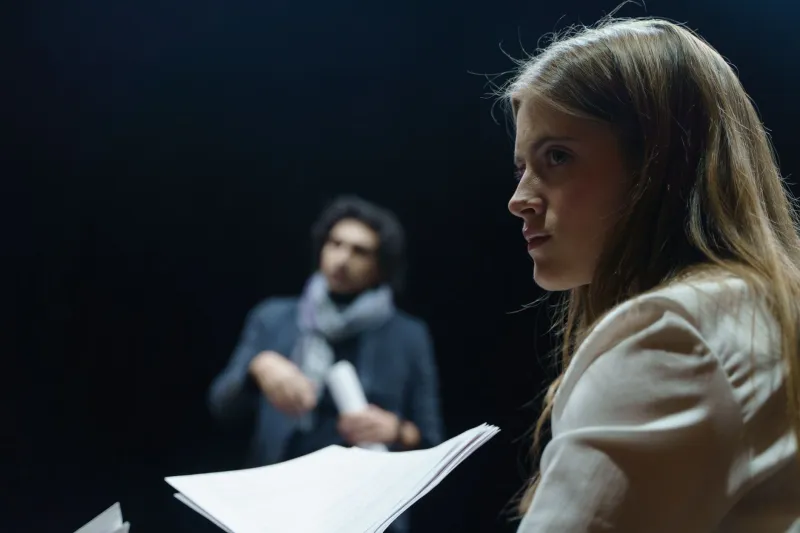
That means sitting across from a scene partner and doing almost nothing — watching them, tracking the micro-expressions that flicker across their face, noticing when their breathing shifts, registering what their hands do when they're uncertain. It sounds passive. It is anything but.
Active listening, as it's understood in European performance training, is a full-body athletic event. You're not waiting for your cue. You're not mentally rehearsing your next line. You're genuinely processing what the other person is doing, in real time, and allowing that to shape what comes out of you next.
The difference between a performer who does this and one who doesn't is enormous — and audiences feel it even when they can't name it.
What "Projection" Culture Actually Costs
American theater training has deep roots in the idea that a performer must conquer the space. That's not entirely wrong — stage presence is real, and audiences do need to feel you. But the emphasis on projection can produce performers who are technically impressive and emotionally sealed.
You've seen this. The actor who delivers every line with precision and intention, but who somehow never quite lands. The scene that feels like two monologues happening in the same zip code. The audition that checks every box and leaves you cold.
What's missing is almost always responsiveness. The ability to be genuinely moved by what the other person is doing. The willingness to let the performance breathe and shift based on what's actually happening in the room.
European ensemble training builds this by design. Performers spend weeks — sometimes months — in exercises where they're explicitly forbidden from pushing. From projecting. From leading. The only instruction is: watch, wait, respond.
The Stanislavski Thread Nobody Talks About
Here's an irony worth noting: Stanislavski, the Russian theater practitioner whose work forms the backbone of American Method acting, wrote extensively about listening. His concept of "communion" — the genuine, moment-to-moment exchange between performers — is central to his system.
But somewhere between Moscow and New York, that piece got underemphasized. American interpretations of Stanislavski's work tended to focus on emotional memory, on personal truth, on the interior life of the actor. The relational dimension — the space between performers — got less attention.
European training traditions, particularly those influenced by Brecht, by physical theater, and by the ensemble culture that defines state-funded theater companies, kept that relational dimension front and center. The scene isn't yours. It belongs to the space between you and your partner.
Practical Shifts Any Performer Can Make
You don't need to enroll in a three-year European conservatory to start training this muscle. Here are approaches that working American performers have used to retool their listening habits:
The 30-Second Delay Exercise. Before running a scene, sit with your scene partner in silence for 30 seconds and do nothing but observe them. Not the character — the person. Notice their energy, their tension, their mood. Then begin. You'll be surprised how much that changes your first line.
Kill the Internal Monologue. During a run-through, actively catch yourself whenever you're mentally rehearsing your next speech while your partner is talking. That's not listening — that's waiting. Practice letting go of what's coming next and trusting that it'll arrive when you need it.
Response Before Action. After your scene partner finishes speaking, give yourself one full breath before you respond. Not a theatrical pause — just a genuine moment of processing. This alone can transform the rhythm of a scene.
Watch Without Judging. In rehearsal, run a scene where your only job is to watch your partner and track every single thing they do. Don't evaluate it. Don't react to it. Just witness it. Then switch.
What This Looks Like Onstage
The performers who've made this shift describe it the same way: they stop performing at the audience and start performing with the room. The scene becomes something that's actually happening, rather than something being executed.
Audiences are extraordinarily good at sensing this distinction, even without any theater training. They lean forward. They go quiet. They stop checking their phones. Something in the human nervous system recognizes genuine presence and responds to it.
That's what European ensemble training is ultimately building toward. Not a technique in the narrow sense — not a trick or a tool — but a fundamental orientation toward performance as a shared, relational event.
And the wild thing is, it starts with something we all know how to do. Or used to, before someone told us to project.
Listen first. The rest follows.